
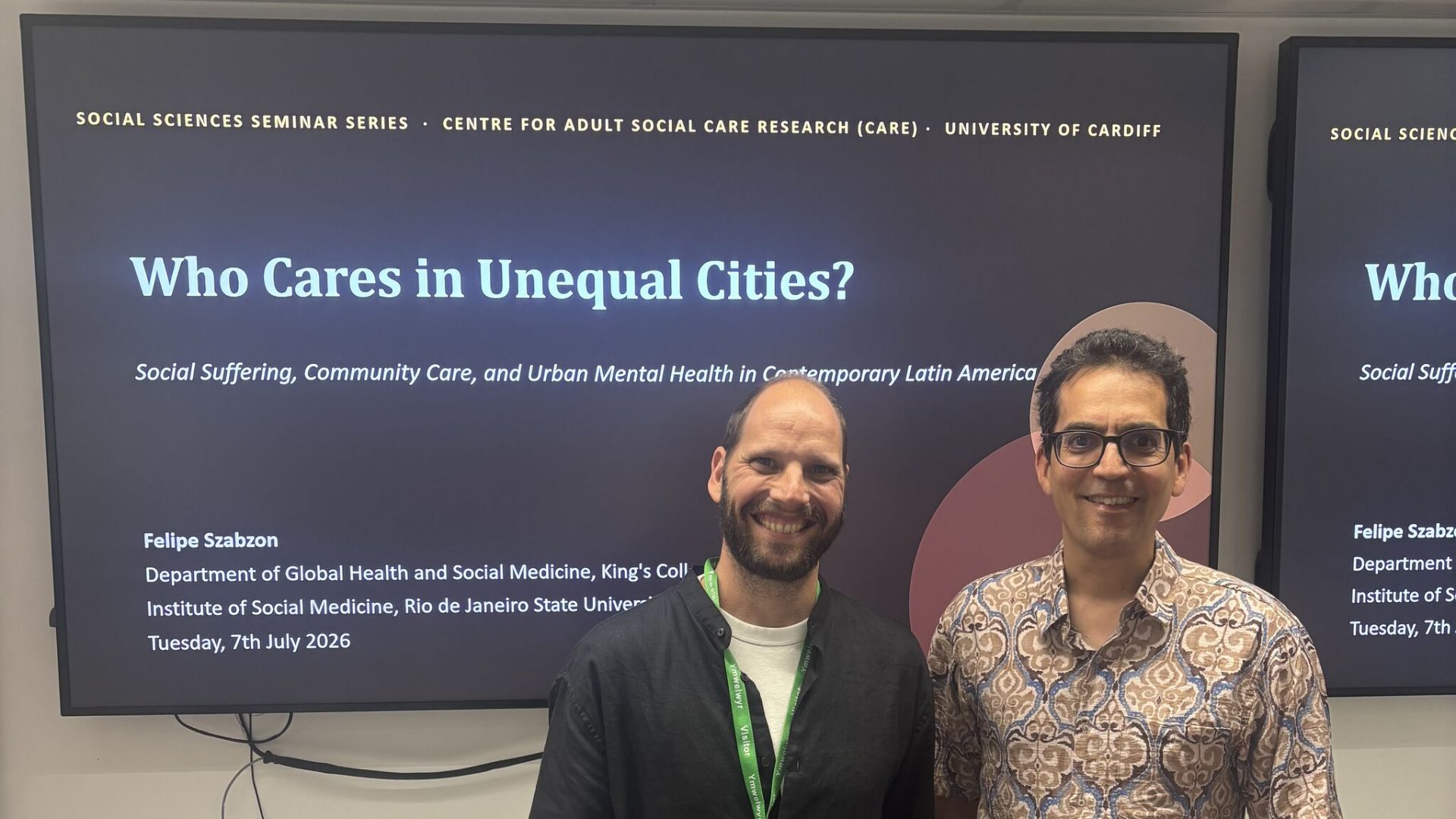
Felipe Szabzon
On the 7th and 8th of July, CARE was delighted to host Dr Felipe Szabzon, a visiting researcher from University of São Paulo and King’s College London, whose work explores urban mental health, community care, and social inequality especially in Brazil. Hosted by Dr Jeremy Dixon. Pelipe presented the seminar, “Who Cares in Unequal Cities?” to a room full of Sociological and Geographic academics
For much of the twentieth century, mental health care in Brazil centred on large psychiatric hospitals. During the 1980s and 1990s, as the country returned to democracy, a social movement emerged to challenge this model. Campaigners argued that people experiencing mental distress should have the right to live in their communities and participate in society, rather than spend long periods in institutions.
These changes led to the creation of a network of community mental health centres known as CAPS. Today, these services provide support, therapy and crisis care within local communities as part of Brazil’s public health system, known as SUS.
As mental health care moved beyond hospital walls, the role of social workers became increasingly important. Their work extends far beyond clinical treatment. Social workers help people access benefits, secure housing, reconnect with family members, obtain documentation, and navigate complex welfare services. In practice, they often support the social conditions that make recovery possible.
This became particularly clear during the COVID-19 pandemic. In research conducted in a low-income area of São Paulo, my colleagues and I found that disruptions to everyday support services had a major impact on people’s mental wellbeing. When welfare services reduced activities or temporarily closed, many families lost access to practical forms of support that helped them cope with daily challenges.
One participant, whom we call E., cared for her teenage son, who has autism. Before the pandemic, he attended a local support centre where he received psychological support and followed a structured routine. When the centre closed, he lost access to both. At the same time, E.’s husband lost his job, increasing financial pressure on the family. E. described feeling overwhelmed and increasingly anxious. When the service eventually reopened, even with reduced activities, she reported feeling calmer and better able to manage everyday life.
Cases like this highlight an important lesson: mental health is not shaped only by access to doctors, psychologists or medication. It is also influenced by housing, income, education, social support and community services. When these systems fail, mental health often suffers as well.
For social workers, this means acting as a bridge between different parts of the support system. Many help individuals and families navigate health, welfare and community services that are often poorly connected. Others work closely with local organisations and community groups to fill gaps where formal support is limited.
Brazil’s psychiatric reform is often remembered for closing institutions and expanding community services. Yet one of its most important lessons may be the central role of social workers in helping people build meaningful lives in the community. Recovery depends not only on treatment, but also on the practical and social support that allows people to participate fully in everyday life.
Read more:
Bruhn L, Szabzon F, Abarca Brown C, Ravelli Cabrini D, Miranda E, Andrade LH. (2022) Suspension of social welfare services and mental health outcomes for women during the COVID-19 pandemic in a peripheral neighborhood in São Paulo, Brazil. Frontiers in Psychiatry. https://doi.org/10.3389/fpsyt.2022.897276
Resende B, Fonseca Guimarães J, Amâncio Caetano A et al. (2026) Nationwide decline in psychiatric hospitalizations and costs in Brazil, 2008–2022: a retrospective descriptive study evidencing reform-driven community mental health gains. The Lancet Regional Health – Americas https://doi.org/10.1016/j.lana.2026.101425
